The One Lamp Rule for Softer Evenings
Turn the overhead light off, turn one lamp on, and see what happens to the room. A plain guide to lighting a home with lamps, from the bulb to where you put it.
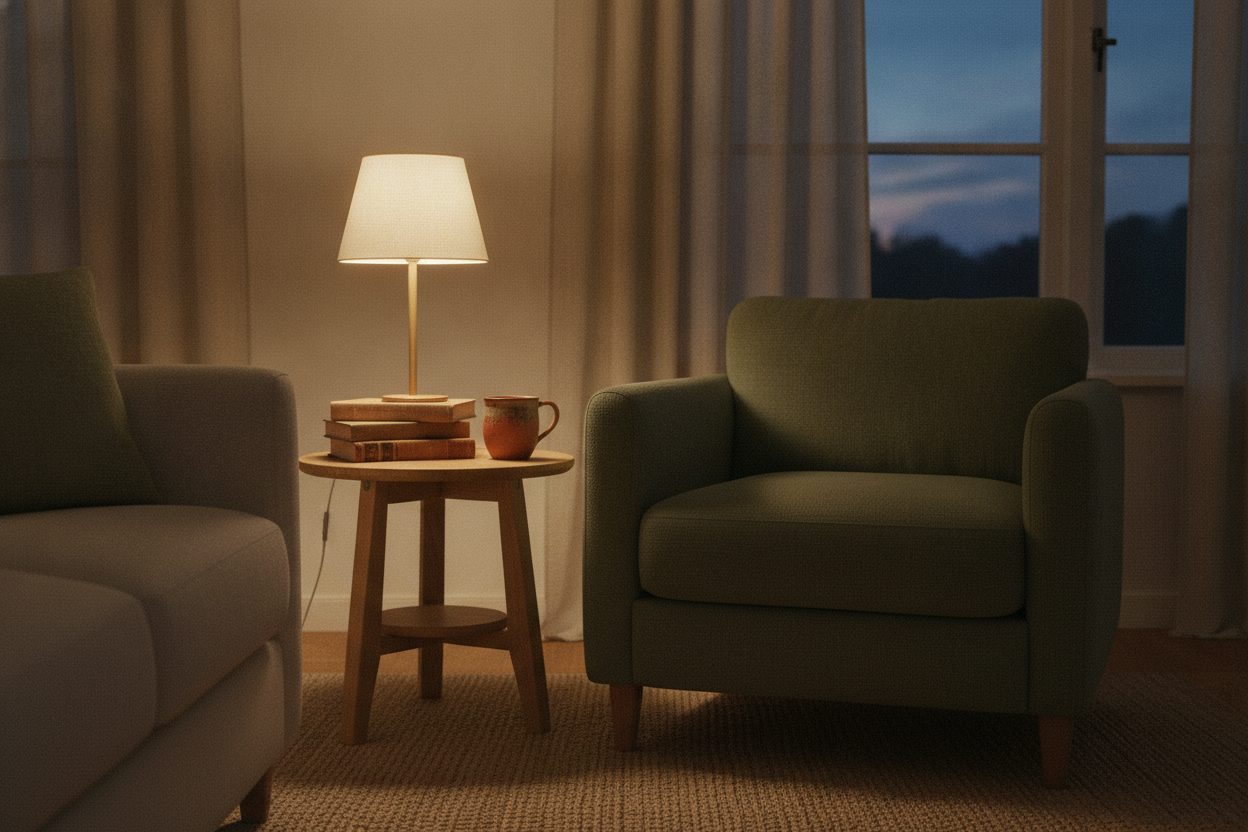
Here is the rule. When the sun goes down, the ceiling light stays off. One lamp goes on in each room you are using. That is the whole thing.
It sounds too small to matter. Try it for a week and you will find that it changes how the evening feels more than anything you could buy. The room gets quieter. People sit down. Conversations last longer. Nothing about the house has changed except where the light is coming from, and it turns out that was most of the problem.
This is a guide to doing it properly, without spending much and without turning your living room into a showroom.
Why overhead light makes a room feel like a waiting room
A single ceiling fixture lights everything equally from above. That is useful for finding a dropped earring and terrible for living. It flattens faces, throws shadows under the eyes, and puts a glare on every surface at once. There is nowhere for your eye to rest because everything is equally bright.
It also tells your body it is midday. Light from above is daylight. Light from low and to the side is firelight, lamplight, the end of the day. Your eyes have known the difference for a very long time, and so has your sense of when to wind down.
Lamps light the parts of the room that are in use and let the rest fall into soft shadow. That contrast is what makes a room feel like it has depth. It is also what makes it feel like evening.
Where the lamp goes
The lamp goes where you sit. Not where the outlet is, not where it looks balanced from the doorway. Where you actually end up with a cup of tea.
In a living room that usually means beside the sofa or next to the chair you read in. The shade should be roughly at eye level when you are seated, so that you see the glow and not the bulb. A table lamp on a side table does this naturally. A floor lamp works if the shade sits around shoulder height when you are sitting down.
In a bedroom it goes on the nightstand, and if you share the bed, there should be one on each side. In a kitchen or dining room, a small lamp on the counter or sideboard does the job after dinner is cleared. In a hall, a lamp on a console table left on in the evening makes coming home feel different.
Start with one room. The one you spend your evenings in. Get that right before you buy anything else.
Bulbs, in plain terms
The number that matters is color temperature, written in kelvin on the box. Lower is warmer. For lamps you will sit beside in the evening, look for 2700K. It is the color of an old-fashioned incandescent bulb, slightly golden, kind to faces. 2200K is warmer still, closer to candlelight, and lovely in a bedroom. Anything 3000K and up starts to look white, and 4000K or above belongs in a garage.
The second number is brightness, in lumens. For a reading lamp, around 450 to 800 lumens is plenty. For a lamp that is just there to make a corner glow, 250 to 450 is enough. Ignore the old watt-equivalent figures and look for the lumen number.
The third thing to check is whether the bulb is dimmable. Most LEDs now are, but not all, and a lamp that can go down to a quarter of its brightness late in the evening is worth having. If the lamp has a plain on-off switch, a dimmable bulb will not dim by itself, which brings us to the two versions.
The budget version
A secondhand lamp base, a new shade in linen or paper, and a 2700K dimmable LED bulb. The base can come from a thrift store or a relative’s attic. Almost any shape works if the shade is plain and the proportions are right: the shade should be roughly two-thirds the height of the base, and a little wider than the widest part of it.
Add a plug-in dimmer, the kind that sits between the plug and the wall with a slider on a cord. They are cheap and they turn any lamp into a lamp with a low setting.
If you have two or three lamps in the room, a cheap outlet timer or a single smart plug will switch them on together at dusk, so you never have to walk around the room turning things on. The point is for the lamps to already be on when you sit down.
The better version
Replace the bulbs with smart bulbs that can shift color temperature as well as brightness. Set them to warm and bright in the early evening and have them drift down to something close to candlelight an hour before bed. Once it is set up, you do not touch it. The house just gets softer as the night goes on.
Pair the smart bulbs with a lamp that has a good shade. A shade is the thing that turns a bulb into light. Linen diffuses it evenly and gives a warm glow with a soft edge. Paper is lighter and brighter. Pleated silk throws a little pattern. Avoid anything with a glossy white inside, which bounces light harshly, and avoid shades that are open at the top in a room with a low ceiling, because they will put a bright circle on the plaster.
If you have the budget for one real purchase, make it a floor lamp with an arched or angled arm that can reach over the sofa. It lights the seat without needing a table, and it is the most useful single lamp a living room can have.
Three lamps is the number
One lamp is the rule for starting. Three is where most rooms settle. Two at seat level, one somewhere else, often lower, on the floor behind a plant or tucked on a low shelf. The third one does not light anything useful. It gives the room a second layer, and that is what separates a room that is lit from a room that glows.
A room with three lamps and no ceiling light on will feel more expensive than the same room with the ceiling light on and the same lamps off. Nothing else about it has changed.
The mistakes
Buying the lamp before deciding where it goes. The spot comes first, then the lamp that fits it.
Bulbs that are too bright. A 1,600 lumen bulb in a reading lamp is a ceiling light at eye level. Go lower than you think.
Mixing temperatures. A 2700K lamp next to a 4000K one makes the warm lamp look orange and the cool one look blue. Pick one temperature for the whole room.
A shade that is too small. The bulb shows, and the eye goes to the bulb instead of to the room.
Turning the ceiling light back on to find something. Keep a small flashlight in a drawer. The light stays off.
Leaving it until you need it. The lamp goes on before the room gets dark, not after. Switching it on at dusk, while you can still see, is the part that makes the evening feel different from the day.
Then leave it alone
Once the lamp is in the right place and the bulb is right, resist the urge to keep adding. Live with it for a few weeks. You will find yourself sitting in that corner more than you used to, and going to bed a little easier. That is the whole point. Not a lighting plan. One lamp, turned on early, in the place where you actually sit.
Nothing in this piece is sponsored. For the longer version of the argument, the room that finally works makes it in twelve small decisions.