Breakfast for People Who Don't Like Breakfast
You do not have to eat at seven, and you do not have to eat cereal. What a late, small or savory breakfast can look like, and the five that actually get eaten.
Somewhere along the way breakfast became a moral position. Skip it and you have failed before nine. Eat it and you are the kind of person who has their life together. The trouble is that a good number of people simply do not want food when they wake up, and no amount of being told it is the most important meal of the day has changed that.
If that is you, this is not another attempt to convert you. It is a quieter argument: that breakfast is a window, not a time, and that what you eat in it matters more than when the window opens.
Why forcing it fails
Appetite in the morning is partly habit and partly biology, and both are stubborn. Some people wake hungry. Others wake with a stomach that wants coffee and silence and nothing else for two hours. Pushing a bowl of cereal into the second kind of person at seven does not make them a breakfast person. It makes them someone who eats something they do not want, feels slightly sick on the train, and is ravenous by eleven anyway.
Forced breakfasts also tend to be bad breakfasts. When you are eating out of duty you reach for whatever is fastest, which is usually sweet, soft and gone in four minutes. You get the sugar without the staying power, and by mid-morning you are hungrier than if you had eaten nothing at all. The failure is not a lack of discipline. It is the wrong meal at the wrong time.
You are allowed to eat at eleven
The rule that breakfast must happen within an hour of waking is a rule from a cereal box. If your appetite arrives at ten or eleven, eat at ten or eleven. Call it breakfast, call it lunch, call it nothing. The point is to eat something decent before the hunger turns into the kind that makes decisions for you.
A late breakfast has a practical advantage. You are awake enough to notice what you want, and you are usually somewhere with a fridge rather than running for a bus. The meal can be smaller and slower, and it stops you arriving at lunch so hungry that the afternoon becomes a long slide.
One caveat. If “late” keeps turning into “never” and you find yourself eating for the first time at three, that is not a late breakfast. That is skipping, and the crash later in the day is the cost.
Small counts
You do not need a plate. A boiled egg and a piece of fruit is a breakfast. A pot of yogurt with a handful of nuts is a breakfast. Half of last night’s dinner, cold, eaten standing up, is a breakfast. The people who insist on a full table at eight in the morning are welcome to it, but they are describing a preference, not a requirement.
What a small breakfast needs is a little substance, which brings us to the two words that do most of the work.
Protein and fiber, in plain terms
Protein is the part of the meal that keeps you full. Eggs, yogurt, cheese, beans, nuts, fish, meat, tofu. It digests slowly and tells your body that something worthwhile has arrived, so the hunger does not come back in an hour.
Fiber is the part that slows everything down and keeps you steady. It lives in oats, whole grains, fruit, vegetables, beans and nuts. It is also why an apple fills you up and a glass of apple juice does not, even though they started as the same thing.
A breakfast with some of each, in whatever amount you can face, will hold you until lunch. A breakfast with neither, which describes most of what is sold as breakfast, will not. You do not need to count anything. Just ask whether the thing in your hand has some protein in it and some fiber, and if the answer is no to both, add one.
Five breakfasts that do not feel like breakfast
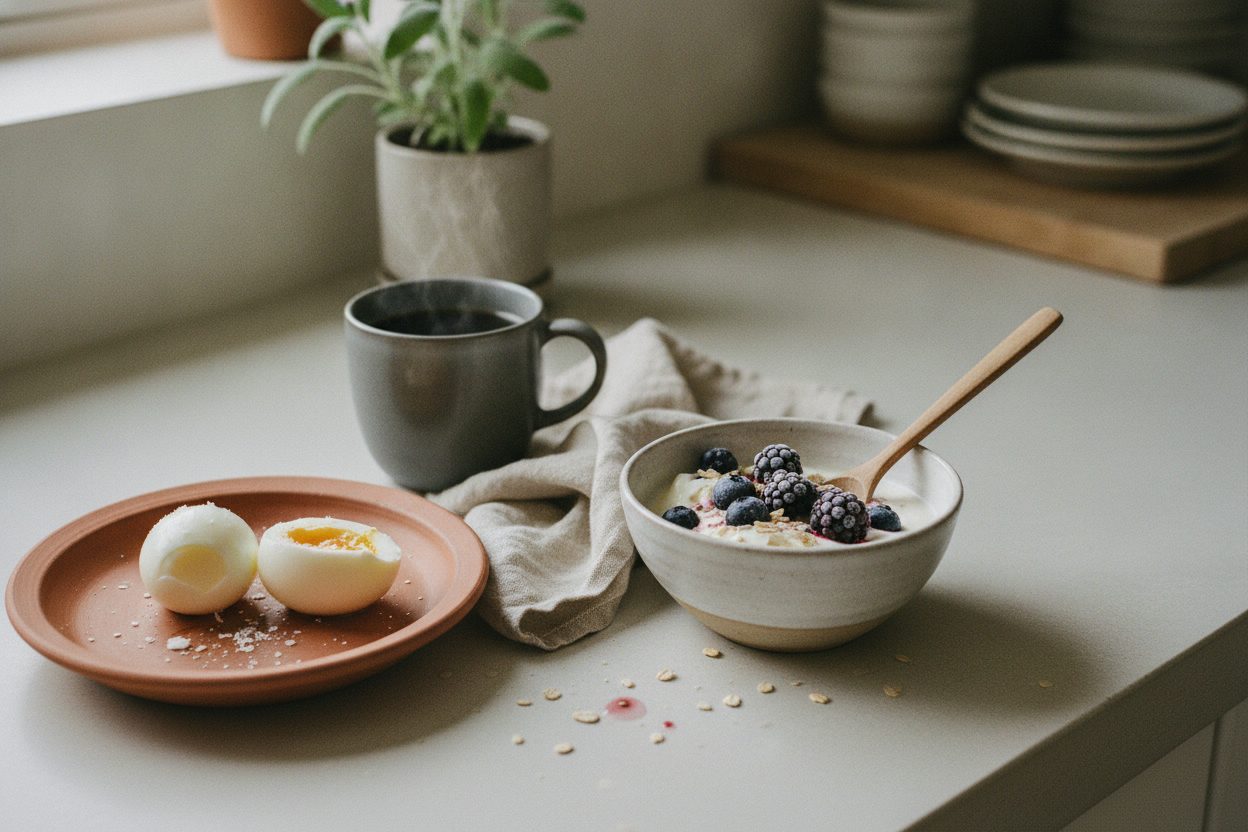
Yogurt, frozen berries, a spoon of oats. Plain yogurt, a handful of berries straight from the freezer, a spoonful of raw oats or chopped nuts on top. Cold, slightly sour, no cooking. It takes a minute, and it is just as good at eleven as at seven.
Two eggs, done the night before. Boil a few eggs on Sunday and keep them in the fridge. Two of them with a piece of fruit, or sliced onto wholegrain toast with salt and pepper, is a breakfast that happens while the kettle boils.
Last night’s dinner. Rice and vegetables. The end of the soup. A slice of frittata. Savory food in the morning is normal in most of the world and strange only here. If you do not want anything sweet before noon, stop trying to.
A smoothie that is actually a meal. Milk or yogurt, a banana, a handful of oats, a spoonful of peanut butter. Blend it and drink it over half an hour. For people who cannot face chewing in the morning, this is the way in. Skip the ones that are only fruit and ice, which are a sugar rush with a straw.
The snack plate. Cottage cheese or hummus, a few crackers, some cucumber or cherry tomatoes, a handful of almonds. Nothing is cooked. Nothing is sweet. It is what you would happily eat at four in the afternoon, moved to half past ten.
What to skip
Boxed cereal, unless it is the plain, dull kind with no sugar near the top of the ingredients. Most of it is dessert with a wholesome picture on the front.
Juice. Fruit with the fiber taken out, which means the sugar arrives all at once and leaves the same way.
Granola bars, and anything described as a breakfast biscuit. They are small, sweet and gone in a minute, and they leave you exactly where you started.
Flavored yogurts. Buy plain and add fruit. The flavored kind can carry as much sugar as a soft drink.
Coffee as a meal. Coffee is fine. Coffee instead of food until two in the afternoon is why the afternoon goes badly.
Make it the size you want
Nobody is handing out marks for breakfast. The goal is not to become someone who sits down to a cooked plate at seven. It is to put something with a bit of protein and a bit of fiber into your body before the hunger starts making your choices, at whatever time your appetite turns up.
For some people that is a full table. For a great many others it is two boiled eggs at a quarter to eleven, eaten over the sink. Both count. Only one of them is pretending to be someone else.
General information, not medical advice. If you have diabetes, a history of disordered eating, or a condition that affects how you eat, talk to a doctor or dietitian before changing your meals.